
QFFM 2023 Programme
JURY PANEL
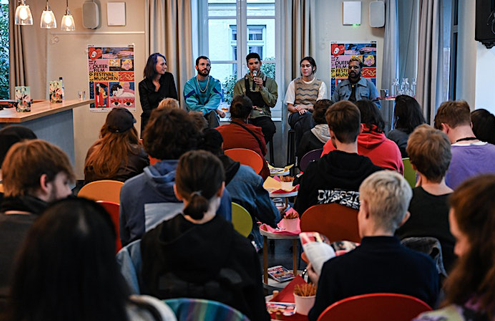
QUEER FILM FUTURES:
WHAT DOES THE QUEER CINEMA OF
THE FUTURE LOOK LIKE?
A panel discussion with QFFM jury members Nicole Kandioler-Biet, Kareem Baholzer and Tucké Royale.
Much time has passed since film critic and scholar B. Ruby Rich coined the term New Queer Cinema in the 1990s, referring to a whole wave of queer filmmaking that was bursting with inventiveness, outstanding aesthetics and radical queerness – and could be seen for the first time also at A-list festivals. When LGBTIQ+ stories began to appear in mainstream productions a couple of years later, and queer films began to lose some of their political explosiveness, an awareness of the importance of intersectional narratives began to emerge. But is that about it? In which direction must and should queer film develop? What are its themes, its aesthetics, its methods? Is there still such a thing as radicality in queer cinema? And if so, how can this be determined?
These and other questions will be discussed in an open conversation with film and media scholar Nicole Kandioler-Biet (University of Vienna), curator & author Kareem Baholzer (XPOSED, Berlinale Panorama) and director, musician and actor Tucké Royale.
© BARBARA MAIER
NICOLE KANDIOLER-BIET
SIE / IHR SHE / HER
Dr. Nicole Kandioler, seit 2020 Tenure Track Professorin der Politiken des Medialen am tfm | Institut für Theater-, Film- und Medienwissenschaft an der Universität Wien. Sie ist seit 2004 forschend und lehrend tätig an der Universität Wien, der Université Rouen, der Universiteit van Amsterdam, der Bauhaus-Universität Rouen, der Johannes Gutenberg-Universität Mainz und war zuletzt, 2022/23, als Vertretungsprofessorin an der Goethe-Universität Frankfurt. Ihre Schwerpunkte beinhalten Gender Media Studies, Osteuropäische Medienkulturen, Dokumentarfilmtheorie.
—
Dr. Nicole Kandioler, since 2020 Tenure Track Professor of the Politics of the Medial at the tfm | Institute for Theater, Film and Media Studies at the University of Vienna. She has been researching and teaching at the University of Vienna, Université Rouen, Universiteit van Amsterdam, Bauhaus University Rouen, Johannes Gutenberg University Mainz since 2004, and was most recently, in 2022/23, a substitute professor at Goethe University Frankfurt. Her areas of specialization include Gender Media Studies, Eastern European Media Cultures, Documentary Film Theory.
© KATJA FELDMEIER
TUCKÉ ROYALE
ER/ IHM HE / HIM
Tucké Royale arbeitet als Autor, Regisseur, Musiker und Schauspieler für Film, Theater und Hörspiel. Tucké lebt in Berlin. Sein Debütfilm Neubau. Ein
Heimatfilm gewann die Preise Bester Spielfilm und Gesellschaftlich relevanter Film beim Filmfestival Max Ophüls sowie den Braunschweiger Filmpreis und den Preis der deutschen Filmkritik. Das von ihm verfasste Manifest „Neue Selbstverständlichkeit“ verhandelt Fragen zu Repräsentationsdilemmata, Anpassungsdruck und Selbstauskünften.
—
Tucké Royale works as a writer, director, musician and actor for film, theater and radio play. Tucké lives in Berlin. His debut film Neubau. Ein Heimatfilm won the Best Feature Film and Socially Relevant Film awards at the Max Ophüls Film Festival as well as the Braunschweiger Filmpreis and the Preis der deutschen Filmkritik. The manifesto he wrote, „Neue Selbstverständlichkeit“ (New Self-Evidence), negotiates questions about representational dilemmas, pressure to conform, and self-exclamations.
© MARBELITE
KAREEM BAHOLZER
THEY / THEM
Im Jahr 1998 im nördlichen Breisgau geboren und aufgewachsen, steigerte sich mit den Jahren sowohl Kareems Leidenschaft für Film, Sound und die Möglichkeiten des Virtuellen; als auch der Drang, Medien aus einer machtkritischen Perspektive zu betrachten. Als Filmschaffende*r mit vielen verschiedenen Blickwinkeln findet sich Kareems Arbeit sowohl im institutionellen Rahmen; u.a. in der Sichtung für Sektionen Panorama und Perspektive Deutsches Kino Sektionen der Berlinale, als auch in alternativen Strukturen wie z.B. dem Kollektiv BipocFilmSociety und dem queeren Filmfestival Xposed wieder.
—
Born and raised in 1998 in northern Breisgau, Germany, Kareem‘s passion for film, sound and the possibilities of the virtual has grown over the years, as has their urge to view media from a power- critical perspective. As a filmmaker with many different perspectives, Kareem‘s work can be found both in the institutional framework; e.g. in the screening for sections Panorama and Perspektive Deutsches Kino sections of the Berlinale, as well as in alternative structures such as the collective BipocFilmSociety and the queer film festival Xposed.